Adhesives for Bonding Plastics and Metals
Bonding materials with significantly different properties, such as plastics and metals, is not a simple task. It requires selecting and correctly using adhesives appropriate to each material.
This article explains in detail why bonding plastics and metals is difficult, specific methods to improve adhesion, and how to choose the optimal adhesive.
Table of contents
- Reasons Why Bonding Plastics and Metals is Difficult
- Methods to Improve Adhesion Between Plastics and Metals
- Adhesives Types for Bonding Plastics and Metals
- “DENACOL,” an Additive for Enhancing Epoxy-Based Adhesives
Reasons Why Bonding Plastics and Metals is Difficult
Bonding dissimilar materials presents various challenges due to differences in their respective properties.
Signifcant Differences in Material Properties
Adhesive bonding is a convenient method for joining dissimilar materials; however, because it relies on intermolecular forces, it inherently limits bond strength. Metals generally have high surface energy and are therefore easy to bond, whereas plastics have low surface energy and are hydrophobic, which makes them difficult to bond.
In particular, plastics such as polyethylene (PE) and polypropylene (PP) tend to repel adhesives, much like water-repellent coatings, making it difficult for general-purpose adhesives to achieve sufficient bond strength.
Differences in Thermal Expansion Behaviour
Metals and plastics have significantly different coefficients of thermal expansion, which can lead to warping and distortion at the bonded interface. In addition, adhesive joints may exhibit lower strength than other joining methods, depending on the conditions, making them more susceptible to failure under high loads.
Plastics undergo significant expansion and contraction in response to temperature changes, whereas metals exhibit relatively little dimensional change. This difference results in high stress being applied to the adhesive layer.
Furthermore, thermal curing processes and temperature fluctuations in the service environment can easily cause component deformation and adhesive failure. Repeated thermal stress, particularly in outdoor or high-temperature environments, can significantly degrade long-term durability
Effects of Contamination and Surface Films
Contaminants and surface films on bonding surfaces are major factors that hinder adhesion between metals and plastics.
In plastics, mold release agents used during molding, surface degradation caused by processing, and dust attracted by static electricity can all lead to poor adhesion. In metals, oils such as rust inhibitors and cutting fluids reduce wettability, while fragile surface layers such as red rust and oxide films can cause failure at the bonded interface. When these factors are present, adhesives cannot perform as intended, making it difficult to achieve sufficient bond strength.
The table below summarizes the above-discussed differences.
| Plastics | Metal | |
|---|---|---|
| Surface energy | Low (PE, PP: approx. 30 mJ/m²) |
High (Aluminum: approx. 160 mJ/m²) |
| Coefficient of thermal expansion |
Large (PP: approx. 70 × 10⁻⁶/°C) |
Small (Steel: approx. 12 × 10⁻⁶/°C) |
| Strength and stiffness | Low | High |
| Effect of surface condition | Mold release agents and dust cause adhesion failure |
Oil films, oxide layers, and rust cause adhesion failure |
Because of these reasons, when bonding plastic and metal, it is necessary to implement measures to improve adhesion
Methods to Improve Adhesion Between Plastics and Metals
For the above reasons, successfully bonding plastics and metals requires specific measures to improve adhesion.
Surface Preparation and Treatment
Surface preparation has a major impact on bond strength when bonding plastics to metals. Roughening the surface with sandpaper or similar methods increases mechanical interlocking, and it is essential to thoroughly remove dust and debris after abrasion. Degreasing with alcohol or acetone is also necessary to remove oils and contaminants.
IPrimer treatment is effective for hard-to-bond plastics because it improves compatibility with adhesives. More advanced approaches include surface modification techniques, such as plasma or corona discharge treatment, which enhance hydrophilicity and promote adhesion.
Adhesive Selection
Adhesives used for bonding plastics to metals have different characteristics. Because no universal adhesive exists, selecting an appropriate product based on the application and service environment is essential.
- Epoxy-based adhesives: Provide high strength and durability and are suitable for structural applications; however, they require long curing times and have low impact resistance.
- Instant adhesives (cyanoacrylate adhesives): Cure rapidly and are easy to use, but have low resistance to heat, water, and impact.
- Urethane-based adhesives: Are flexible and highly impact-absorbing, but their long-term durability is somewhat limited.
- Silicone-based adhesives: Offer excellent heat resistance and weatherability, but have low adhesive strength, making them more suitable for sealing applications.
Considering these characteristics, selecting an appropriate adhesive is crucial.
Optimization of the Bonding Process
As a general rule, adhesives should be applied in a thin, uniform layer. Applying too much adhesive can lead to incomplete curing or the formation of gaps due to shrinkage, while applying too little may result in an insufficient bond line. After application, the bonded surfaces should be pressed together to ensure intimate contact and fixed in place to prevent misalignment.
It is also important to allow sufficient curing time as specified for each adhesive. Specifically, adhesives such as epoxy systems that require longer curing times should not be moved or subjected to loads before curing is complete. Allowing the assembly to remain undisturbed for the duration specified in the manufacturer’s instructions ensures that the adhesive achieves its maximum performance.
Consideration of the Service Environment
Because each adhesive is designed to withstand different environmental conditions, it is necessary to select a product suitable for the intended service environment. In wet areas or high-humidity environments, water-resistant types should be used; in high-temperature locations, heat-resistant types are required; and for outdoor applications, weather-resistant types that can withstand ultraviolet radiation and rain are essential. Epoxy-based adhesives, in particular, offer excellent resistance to heat, chemicals, and weathering, and provide stable performance even under harsh conditions.
However, adhesive joints are vulnerable to localized loads. Therefore, combining adhesive bonding with mechanical fastening methods such as screws or rivets can improve the reliability of the joint.
Adhesives Types for Bonding Plastics and Metals
Each adhesive has different characteristics, with significant differences in strength, curing time, durability, and workability.
Epoxy-Based Adhesives
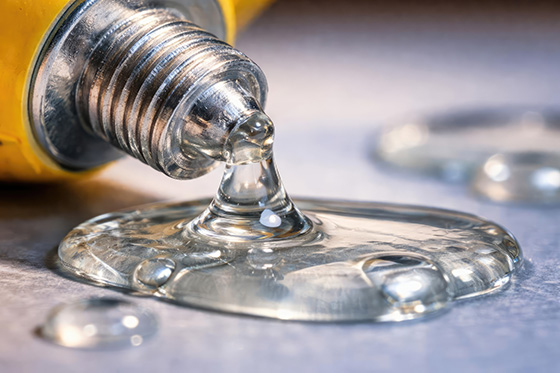
Epoxy-based adhesives are one of the most reliable options for bonding plastics and metals. Mixing a resin with a curing agent causes a chemical reaction that forms a three-dimensional crosslinked network. Because of these properties, industries such as automotive, aerospace, and construction use them widely.
Epoxy adhesives typically offer heat resistance in the range of −50°C to 200°C, and specialized grades can withstand temperatures exceeding 300°C. They also provide excellent chemical resistance, water resistance, and electrical insulation properties. Epoxies form strong chemical bonds with metals, and appropriate surface treatment enables strong adhesion to plastics. However, long curing times and post-curing brittleness make them less impact-resistant.
Instant (Cyanoacrylate) Adhesives
Instant (cyanoacrylate) adhesives react with moisture in the air and harden within a few seconds to several tens of seconds. Their ease of use and high work efficiency make them suitable for applications ranging from household repairs to industrial purposes.
However, once cured, they become brittle and are vulnerable to impact and vibration. Their resistance to water and heat is also limited, which makes them unsuitable for applications requiring long-term durability.
In addition, they are effective only in very narrow bond gaps, making them unsuitable for uneven surfaces. They may also fail to provide sufficient bonding performance with hard-to-bond plastics such as polyethylene and polypropylene.
For these reasons, instant adhesives are generally recommended for auxiliary or temporary bonding applications. When structural strength is required, epoxy-based or urethane-based adhesives, or a combination with mechanical fastening, is more effective.
Urethane-Based Adhesives
Urethane-based adhesives provide an excellent balance of flexibility and strength for bonding plastics and metals.
Urethane adhesives are available in one-part and two-part systems. One-part types typically cure by reacting with moisture in the air and are easy to handle because they do not require mixing. Two-part types require mixing a base resin and a curing agent and allow easier control over curing speed and mechanical properties.
Due to their post-cure elasticity, urethane-based adhesives effectively absorb stresses caused by thermal expansion and vibration, thereby preventing delamination or joint failure. This makes them highly reliable for impact-heavy environments, such as those found in the automotive and railway industries.
Silicone-Based Adhesives
Silicone-based adhesives consist primarily of silicone polymers with siloxane backbones, which provide stable performance under harsh environmental conditions.
They operate over a wide temperature range from −60°C to 200°C, resisting degradation at high temperatures while maintaining flexibility at low temperatures. Their excellent heat resistance and weatherability make them suitable for outdoor applications and wet environments. However, their adhesive strength is relatively low, which makes them more suitable for sealing than for structural bonding.
“DENACOL,” an Additive for Enhancing Epoxy-Based Adhesives
When bonding plastics and metals with epoxy-based adhesives, incorporating DENACOL helps address challenges associated with conventional epoxy adhesives and enables more reliable bonding.
Overview of DENACOL
DENACOL is a collective term for multifunctional epoxy compounds with unique molecular structures that differ from conventional bisphenol-type epoxy resins.
Its aliphatic backbone provides flexibility, excellent weather resistance, and, in some grades, water-solubility. These properties make DENACOL suitable for environmentally friendly adhesives designed to reduce VOC emissions.
Manufacturers rarely use DENACOL on its own. Instead, they incorporate it as a modifier in epoxy-based adhesives to improve material properties and adjust viscosity. In bonding plastics to metals, it plays an important role in enhancing interfacial adhesion.
Key Characteristics of DENACOL
The most significant feature of DENACOL is its high performance derived from multifunctionality. While conventional epoxy resins are typically difunctional, DENACOL futures three or more functional groups, enabling the formation of a high-density, three-dimensional crosslinked network during curing. This significantly enhances mechanical strength, thermal resistance, and chemical resistance, thereby improving the overall reliability of bonded joints.
DENACOL also offers low viscosity and excellent workability. Many grades are water-soluble, making them ideal as reactive diluents and for developing environmentally friendly adhesives. Its minimal shrinkage during curing reduces internal stress. In addition, the aliphatic backbone provides flexibility that facilitates stress relaxation between dissimilar materials. Another major advantage is its ability to interact with the surfaces of both plastics and metals, thereby improving interfacial adhesion.
Why DENACOL is Effective for Bonding Plastics and Metals
DENACOL acts on both plastics and metals through its unique molecular structure. Its epoxy groups react with metal oxide layers and other surface species, thereby enhancing interfacial adhesion and improving bond strength.
In addition, the combination of a highly dense crosslinked structure and inherent flexibility allows DENACOL to absorb temperature fluctuations and mechanical stress, maintaining strong adhesion over the long term.
DENACOL improves adhesion between dissimilar materials, an area that has traditionally been challenging. If you are experiencing issues with bonding plastics and metals, please feel free to contact us for more information.
Inquiries and Sample Requests
For more information or sample requests, please feel free to contact us.
Inquiry / Sample request