
- Electrification
- Global
Innovative Binder Solutions to Overcome Challenges in Lithium-Ion Batteries (Downloadable Product Information Sheet Included)
As global electrification continues to advance, the need for lithium-ion batteries (LiBs) with enhanced performance and extended lifespan is growing rapidly. While progress in battery technology persists, significant technical barriers still limit the practical deployment of next-generation systems. To address these challenges, NAGASE Mobility—partnering with a leading strategic collaborator—has developed an advanced binder optimized for high-capacity silicon anodes. This proposal outlines our solution and demonstrates a viable pathway to overcoming critical technical limitations.
The Issue
Current Challenges with Silicon-Based Anodes Reduced Cycle Life
Reduced Cycle Life
Repeated charge/discharge cycles lead to structural degradation of the active material, reducing battery capacity. Overcharging or deep discharging—especially under high temperatures or high rates—can accelerate this degradation, significantly shortening battery life.Increased Internal Resistance
Use over time causes the electrode surface film (SEI layer) to grow, increasing internal resistance. This results in heat generation, decreased energy efficiency, and a reduction in usable battery capacity.
Structural Damage from Electrode Expansion
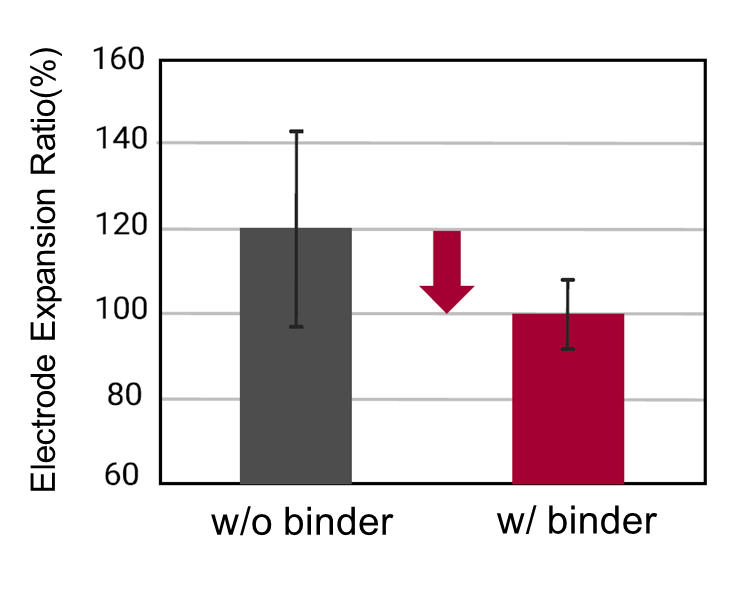
Silicon-based active materials, known for high capacity, undergo significant volume changes during cycling. This causes severe damage to the electrode structure. Conventional binders struggle to maintain adhesion under these conditions without increasing resistance.
The Solution
NAGASE Mobility’s Solution
High-Strength Binder Optimized for Active Materials
Our binder exhibits excellent adhesion to silicon-based materials while significantly improving structural stability. By optimizing the molecular weight and bonding sites of acrylic polymers, we enhance both binding strength and electrostatic interaction with Si and graphite, effectively preventing active material detachment and extending cycle life.
Binder Usage Optimization
Despite point-contact application, the binder delivers high bonding strength, enabling reduced binder usage without compromising performance. This increases contact between active particles and contributes to lower internal resistance.
Improved Energy Density
Lower internal resistance results in reduced heat generation and more efficient charge/discharge cycles, helping to maintain battery capacity over the long term.
The Results
Proven Results and Anticipated Impact
Batteries using our binder demonstrate significantly increased cycle counts
and stable discharge capacitycompared to those without.
The solution mitigates issues like electrode expansion and rising internal resistance, allowing for next-gen battery designs that support higher capacities.
Applications extend beyond electric vehicles (EVs), offering great promise for stationary energy storage systems, contributing to stable renewable energy supply.
NAGASE Mobility’s innovative binder technology addresses critical performance challenges in lithium-ion batteries. By combining high-capacity silicon anodes with specially formulated acrylic-based binders, we offer optimized solutions to support both development and mass production of next-generation batteries. We welcome the opportunity for you to explore this technology and consider it for your future energy storage systems.
Looking for performance data? Our product information sheet provides a comprehensive overview of this binder's capabilities.
Download the Product Information Sheet
Contact NAGASE Mobility using the link below for detailed materials or technical inquiries. We’re here to help.