Resources ~ DENATRON Museum ~ / Get to know DENATRON
Conductive Polymers for Hybrid Capacitors
HOME > Resources ~ DENATRON Museum ~ > Get to know DENATRON > Conductive Polymers for Hybrid Capacitors
- What are Conductive Polymers?
- Types of Capacitors That Use Conductive Polymers
- Types of Conductive Polymers Used in Capacitors
- Conductive Coating Material for Capacitors, DENATRON
One of the factors that influences the performance of electrolytic capacitors is the conductive material used between the electrodes. In recent years, types that use conductive polymers—polymeric materials—as a substitute for electrolytes have been attracting attention.
In this article, we will explain the basic structure of conductive polymers, their doping mechanisms, and the strengths of “Denatron,” a product provided by Nagase ChemteX Corporation.

What are Conductive Polymers?
A conductive polymer is a material that can conduct electricity.
A polymer is a compound created by the polymerization of monomers (single molecules). After polymerization, it gains electrical conductivity through a process called doping, which modifies its structure.
Types of Capacitors That Use Conductive Polymers
Capacitors utilizing conductive polymers can be broadly divided into two types.
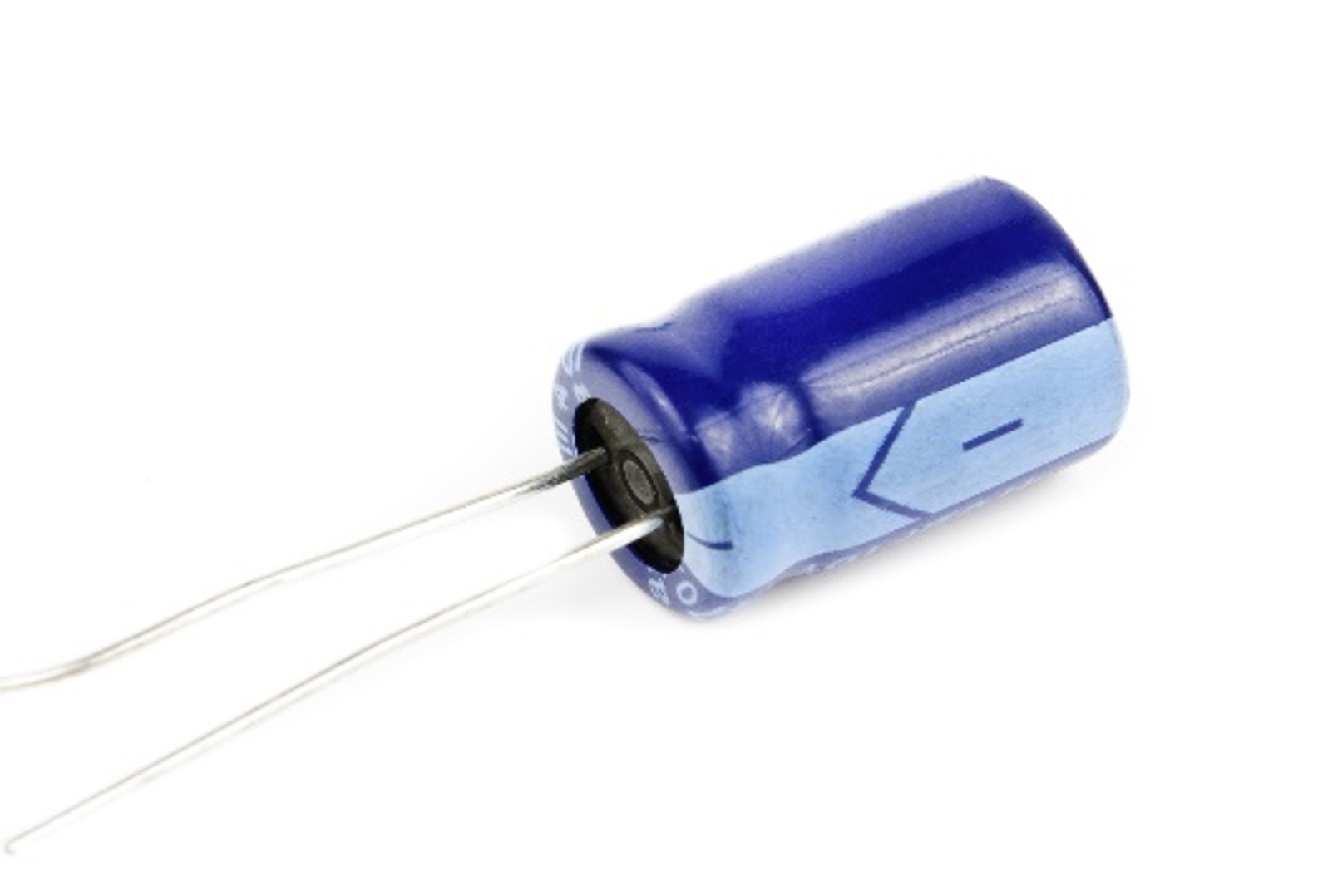
Conductive Polymer Hybrid Aluminum Electrolytic Capacitor
A conductive polymer hybrid aluminum electrolytic capacitor uses aluminum as the electrode and combines the properties of an electrolyte and a conductive polymer.
There are three types of electrolytic capacitors:
● Electrolyte type
● Conductive polymer type
● Hybrid type (electrolyte + conductive polymer)
An electrolyte-type capacitor consists of an anode covered with an oxide film, a separator impregnated with an electrolyte, and a cathode. The oxide film has the property of allowing
the current to flow in only one direction. As a result, the electric current flows from the anode through the dielectric separator to the cathode.
In contrast, the conductive polymer type is an aluminum electrolytic capacitor that uses a conductive polymer instead of an electrolyte as the dielectric material. Compared with the
electrolyte type, it offers advantages such as a higher ripple current (the current that can flow through the capacitor) and lower equivalent series resistance (ESR). However, it also has
disadvantages, including a higher leakage current (LC) and smaller capacitance.
The reason for the large LC lies in the properties of the dielectric material. Since conductive polymers do not inherently possess ionic conductivity, their ability to self-repair the oxide film is inferior to that of the electrolyte type. Therefore, once a defect occurs in the oxide film, an LC begins to flow from that point.
This is where the hybrid-type aluminum electrolytic capacitor proves effective. By combining the advantages of both types, it offers high functionality and user-friendliness.
Table 1. Types and Characteristics of Aluminum Electrolytic Capacitors
Please scroll horizontally.
| Electrolyte Type | Conductive Polymer Type | Hybrid Type | |
|---|---|---|---|
| Electrolyte | Electrolyte | Conductive polymer | Electrolyte + Conductive polymer |
| Capacitance | Large | Small | Large |
| LC | Low | High | Low |
| Ripple Current | Small | Large | Large |
| ESR | High | Low | Low |
Conductive Polymer Tantalum Solid Electrolytic Capacitor
Among the classifications in Table 1, the conductive polymer tantalum solid electrolytic capacitor uses a conductive polymer as the electrolyte and tantalum metal as the electrode. Like aluminum, tantalum is a metal that offers high electrical conductivity and forms a stable oxide film, making it well-suited for use as an electrode in electrolytic capacitors.
In addition, while aluminum electrolytic capacitors are cylindrical in shape, conductive polymer tantalum solid electrolytic capacitors are thin, rectangular, and plate-shaped. Because they are mounted on printed circuit boards with a broad surface area, they are
lower in height and contribute to space-saving designs.
Types of Conductive Polymers Used in Capacitors
There are several types of conductive polymers used in capacitors. In this section, we will introduce four representative types.
PEDOT:PSS
PEDOT:PSS is a conductive polymer composed of poly(3,4-ethylenedioxythiophene) (PEDOT) and polystyrene sulfonic acid (PSS). Because of its excellent stability, transparency, and film-forming properties, PEDOT:PSS is also used in applications beyond capacitors, such as antistatic films and touch panels.
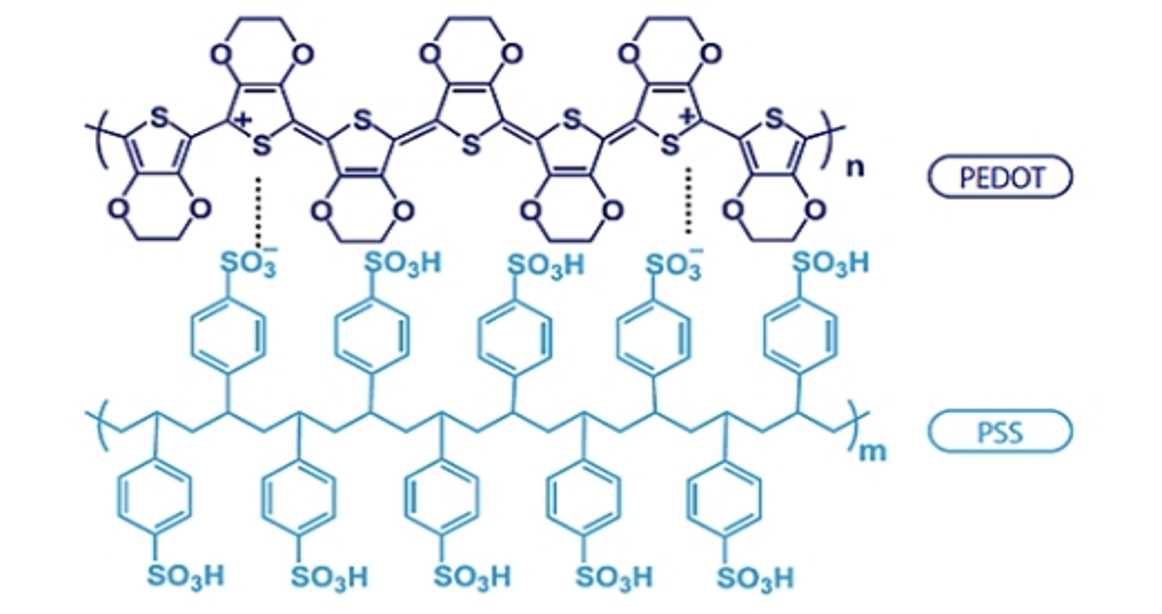
In PEDOT:PSS, the PSS component accepts electrons from PEDOT, resulting in the formation of bipolarons (dications). These charge carriers move within the molecule or hop between molecules, providing the material with its electrical conductivity.
Polypyrrole
Polypyrrole is a material with higher electrical conductivity than electrolytes, and some variants exhibit conductivity levels comparable to those of metals, much like PEDOT:PSS. For this reason, it has long been used as one of the conductive polymer materials.
Its conductivity can be adjusted through doping: conductivity increases upon doping (oxidation) and decreases upon dedoping (reduction). In addition, it is highly stable in air, making it suitable for use in a variety of environments.
While it possesses electrical conductivity comparable to that of metals, it also has the advantage of high flexibility—a property that sets it apart from metals. Consequently, it can be wound into a cylindrical shape like an electrolytic capacitor and can also be utilized as a flexible material.
It also exhibits distinctive temperature characteristics—its conductivity increases when the temperature rises, showing a trend similar to that of semiconductors. However, its conductivity is also influenced by the manufacturing conditions.
Polyaniline
Polyaniline, like other conductive polymers, is used in conductive polymer electrolytic
capacitors. It exhibits high electrical conductivity, although its conductivity varies depending on its oxidation state:
● Fully reduced state (leucoemeraldine)
● Half-oxidized state (emeraldine)
● Fully oxidized state (pernigraniline)
● Emeraldine salt (protonated emeraldine base)
Among these, only the emeraldine salt exhibits electrical conductivity; the other three states are insulators. Its other characteristics are similar to those of polypyrrole, including temperature-dependent conductivity, flexibility, and stability in air.
Polyacetylene
Polyacetylene also has high electrical conductivity, but this depends on the structure of its isomers. There are two isomers—cis and trans—and generally, the trans form exhibits higher conductivity. Unlike other conductive polymers that are stable in air, it is easily oxidized and difficult to process because it is insoluble and does not melt. Regarding temperature dependence, like other conductive polymers, its conductivity increases when the temperature rises.
Conductive Coating Material for Capacitors, DENATRON
Lastly, Denatron, a conductive polymer, is introduced.
What Is DENATRON?
DENATRON is a conductive polymer designed for use in capacitors, consisting of PEDOT:PSS with additives. Thanks to its high electrical conductivity, it is used not only in capacitors but also in flexible devices and touch screens.
In addition, there are types of DENATRON based on carbon nanotubes, but for capacitor applications, only the types based on PEDOT:PSS can be used.
Features of DENATRON
DENATRON has several distinguishing features. First, because it operates through an electronic conduction mechanism, it is less affected by humidity, resulting in more stable electrical conductivity.

In addition, since the surface resistivity can be adjusted within the range of 10² to 10¹⁰ Ω/sq, the conductivity can be controlled from highly conductive (around 10² Ω/sq) to less conductive (10¹⁰ Ω/sq). It also has excellent workability, making it suitable for use in electrolytic capacitors of various sizes.
It also possesses other useful properties for various applications, such as being environmentally friendly and having high transparency.
Application Examples for Aluminum Electrolytic Capacitors
It is applied to aluminum electrolytic capacitors that utilize aluminum foil as the anode/cathode and DENATRON as the dielectric material. Within a certain frequency range, the impedance gradually decreases (indicating higher conductivity), reaching its minimum around 100 kHz, and then increases thereafter. Since the impedance around 100 kHz is
lower than that of commercially available PEDOT:PSS, it can be concluded that DENATRON exhibits superior performance as a conductive polymer.
The specifications of the aluminum electrolytic capacitor (currently under development) employing DENATRON are presented in Table 2.
Table 2. Specifications of the Aluminum Electrolytic Capacitor (Prototype)
Please scroll horizontally.
| Item | Value |
|---|---|
| Conductivity (S/cm) | 500~1000 |
| Viscosity (mPa·s) | 40~100 |
| pH | 7~8 |
| Solid Content(%) | 0.5~15 |
| Particle Size D50(nm) | 2~10 |
| Capacitance(uF) 25℃,120Hz |
119 |
| ESR(mΩ) | 44 |
| tanδ (Loss Tangent) 25℃,120Hz |
0.03 |
| LC(uA) 25℃,10V,after 1 min |
20 |
The aluminum electrolytic capacitor under development is manufactured through the following steps:
1.Welding of lead wires to aluminum foil
2.Formation treatment (anodization)
3.Impregnation and drying of the conductive polymer
4.Application of silver paste
5.Attachment of lead wires
6.Drying and curing
7.Mounting of electrodes
8.Aging process
Contact Us
DENETRON is a conductive polymer designed for use in capacitors, based on PEDOT:PSS, yet it exhibits higher conductivity than commercially available PEDOT:PSS materials.
Nagase ChemteX Corporation serves as a partner in our customers’ product development and quality improvement, providing optimized conductive solutions. For customers seeking assistance in selecting conductive polymers for capacitor applications, please contact us using the information below.
Return to list of articles

