- Electrification
- Global
Nut Holder Integration: A Comprehensive Guide to Processes, Benefits, Challenges, and Applications
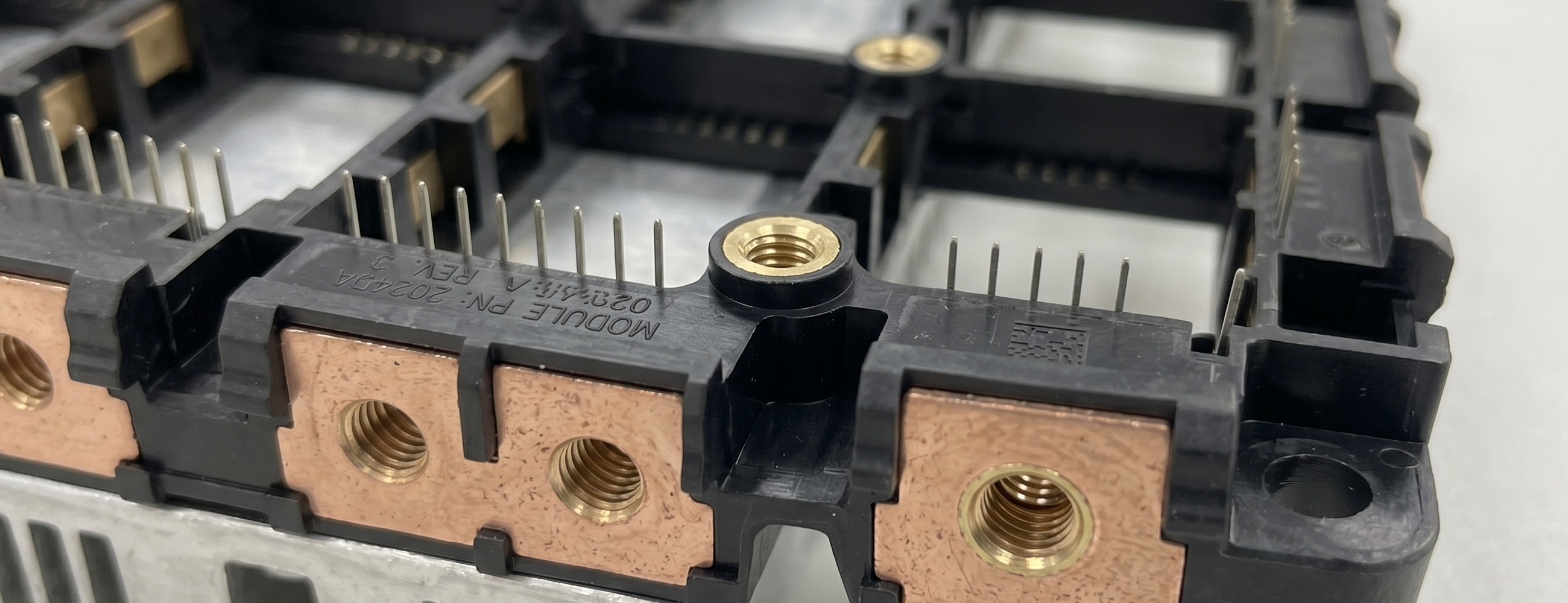
In manufacturing environments where enhancing assembly efficiency and reducing process steps are top priorities, nut holder integration has emerged as an effective solution. By incorporating nuts into resin holders in advance, this approach streamlines assembly operations while simultaneously improving consistency and reliability. This article provides a comprehensive overview of nut holder integration—from its technical process and advantages to its challenges and typical industrial applications.
What Is Nut Holder Integration?
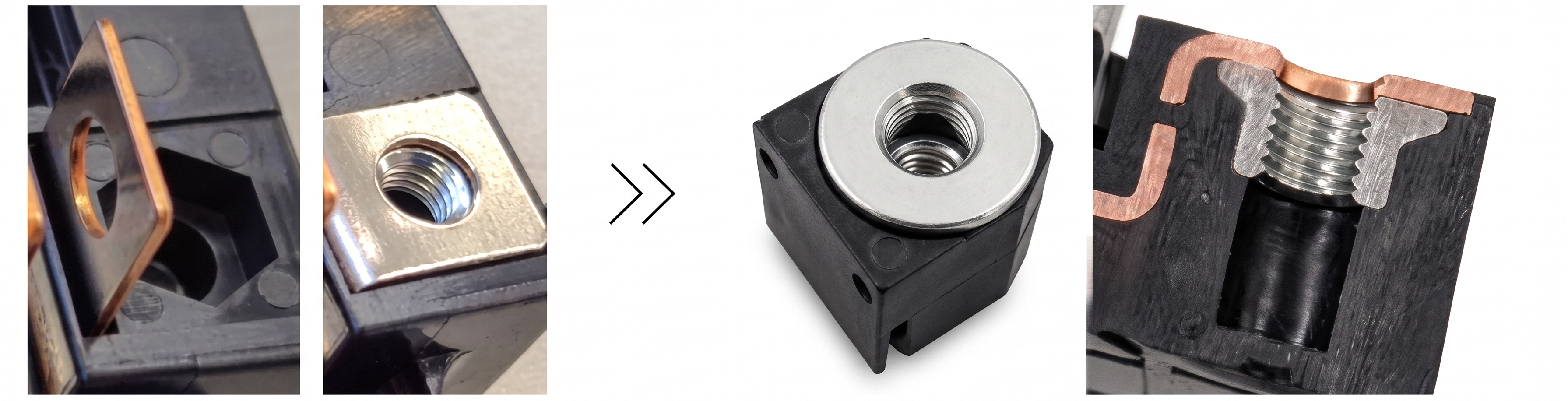
Nut holder integration is a manufacturing method in which a nut is embedded into a resin holder (or cap), transforming it into a single, integrated component. Typically, the resin part is injection-molded first, after which the nut is press-fitted and secured using automated equipment.
This method eliminates the need for manual installation in downstream assembly processes, which reduces labor cost and ensures stable, repeatable fastening quality. Consequently, this approach is widely adopted in sectors like automotive manufacturing, where reliability and precision are critical.
Process Flow
The typical process flow for integrating a nut into a resin holder involves several key stages:
1. Molding of the Resin Holder
The holder that retains the nut is manufactured using injection molding. The holder is specifically designed to prevent both nut rotation, and pull-out, and ensure accurate positioning. To improve material efficiency, manufacturers can sometimes use recycled resin, such as reprocessed runner material from the same product line.
2. Nut Placement
The nut is placed into the pre-molded resin holder. In mass production, automated press-fitting equipment is used to supply and position the nut accurately. Stable feeding and precise positioning are essential, as even slight misalignments in orientation can lead to fastening defects or quality inconsistencies downstream.
3. Press-Fit Fixing
During the press-fitting stage, the nut is inserted into the resin holder and mechanically secured. The retention force is determined by the geometry and dimensional tolerances of the holder. Proper control of press force and fixture design are critical. If conditions are not strictly managed, issues such as “floating”, tilting, or cracking of the resin may occur.
4. Assembly and Integration
The integrated nut-and-holder unit is then assembled into the final product as a unified structure. This eliminates separate nut installation (“outsert” processes), simplifying assembly and improving quality consistency. Additionally, because the holder can cover the nut, it can function like a cap nut. This allows manufacturers to use lower-cost standard nuts instead of more expensive specialty cap nuts, contributing to cost reduction.
Key Benefits
Integrating nuts into resin components provides significant advantages in both quality and operational efficiency:
・Reduced Process Steps :
By supplying nuts already fixed in position, downstream assembly is simplified. This reduces assembly and inspection steps, leading to shorter cycle times and lower labor requirements while minimizing human error.
・Cost Reduction :
In applications where expensive cap nuts are typically required to prevent foreign-object ingress, a resin holder offers a high-performance, lower-cost alternative. By replacing specialty hardware with standard through-nuts and utilizing reprocessed runner material for the holder itself, manufacturers can achieve significant reductions in both component and material costs.
・Improved Dimensional Accuracy :
The holder structure ensures stable nut positioning, reducing variation between parts. This minimizes misalignment compared to manual assembly and maintains consistent dimensional accuracy. This is particularly beneficial for components with multiple fastening points.
・Elimination of Drop-Off Risk :
Since the nut is securely retained within the resin holder, the risk of it loosening or falling out during use is significantly reduced. This maintains stable fastening in environments subject to vibration or repeat loading—enhancing overall product reliability.
Ideal Conditions for Adoption
Nut holder integration is not suitable for all components. Its effectiveness depends heavily on the operating environment and performance requirements, making it important to evaluate the appropriate conditions before adoption. It is most effective when certain performance requirements or environmental factors are present:
・High-Vibration Environments :
Unlike post-installed nuts that may loosen or detach over time, integrated nuts are securely retained within the holder and less susceptible to displacement under external vibration. This is vital for automotive components and electric motors, where vibration conditions are severe and fastening reliability is important.
・High-Precision Applications :
For components with multiple fastening points or strict positional relationships, the holder design ensures the accuracy of nut placement. This reduces variation among parts and prevents fastening defects during final assembly.
・Limited Accessibility :
In confined or hard-to-reach areas, manual assembly can be time consuming and labor intensive, supplying pre-integrated components, significantly reduces on-site assembly effort and improves workability.
Typical Applications
Nut holder integration is particularly effective for components that demand high reliability and precision, particularly in the automotive sector. While traditional outsert methods often struggle with lateral installations—where nuts must be secured into the sides of resin components—integrated holders offer a robust and effective solution.
・EV Busbars and Power Distribution :
Large electrical currents require secure fastening to prevent heat generation and performance degradation. Nut holder integration ensures position stability, electrical connectivity reliability, even structures where nuts must be positioned laterally.
・Power Module Components (IGBT/Inverter) :
These areas are subject to both heat and vibration, making fastening stability a key requirement. Integrated holders allow stable positioning of nuts, improving assembly accuracy and consistency and reduces the burden on operators working in limited space.
・ECU and Control Unit Housings :
Precise nut placement within the housing ensures the accurate positioning of internal boards. In designs requiring side-fastening, using nut holders allows for the use of standard nuts over expensive alternatives.
NAGASE Mobility Insert Molding Solutions for Automotive Components
As electrification accelerates in the automotive industry, fastening technologies that offer both lightweight design and high reliability are essential. Nut holder integration provides the perfect balance between process simplification and high-precision assembly.
At NAGASE Mobility, we leverage advanced insert molding technologies to support the development of complex components and multi-process assemblies. From initial design proposals to full-scale mass production, we provide hands-on support tailored to your specific application. Our comprehensive solutions include:
Selection of optimal metal and resin materials tailored to your application
Design of specialized nut geometries and fixation structures
Optimization of mold designs and structures
Insert Molding for Power Modules | NAGASE Mobility | NAGASE
If you can share your drawings or specifications, we will propose the most suitable solution based on your application and technical challenges.
For inquiries regarding nut holder integration for EV components or any related technical consultation, please feel free to contact us.